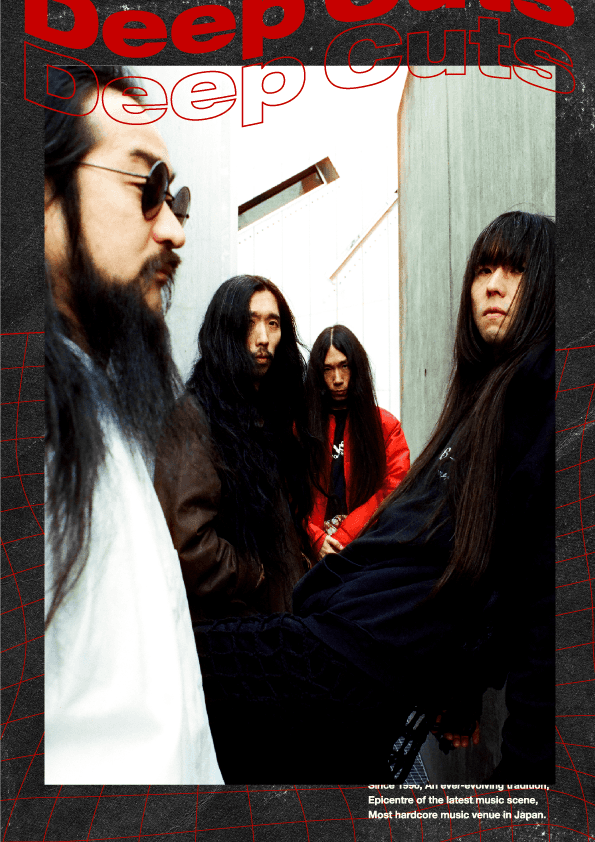
Bo Ningen: A Long-Awaited Return
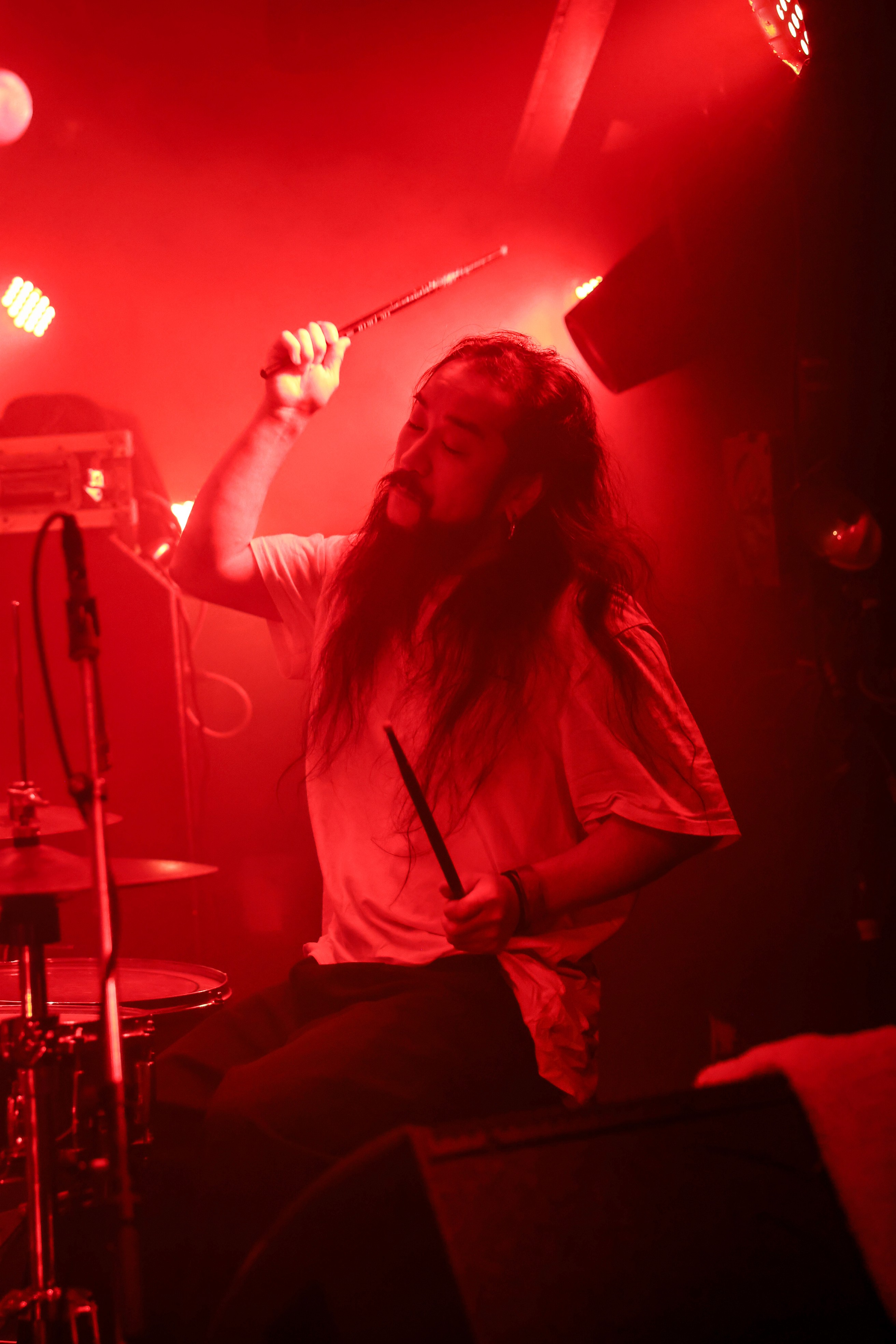
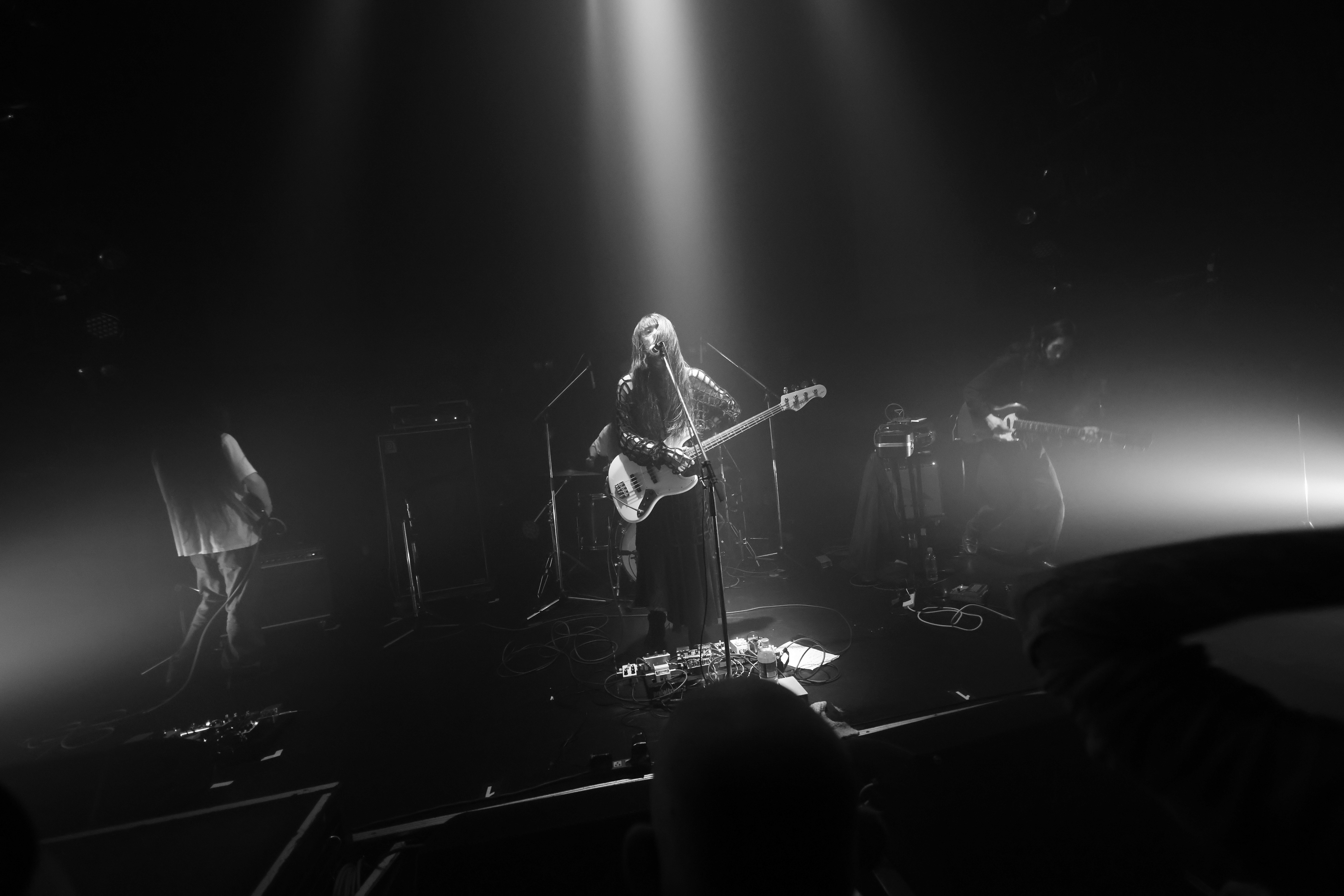
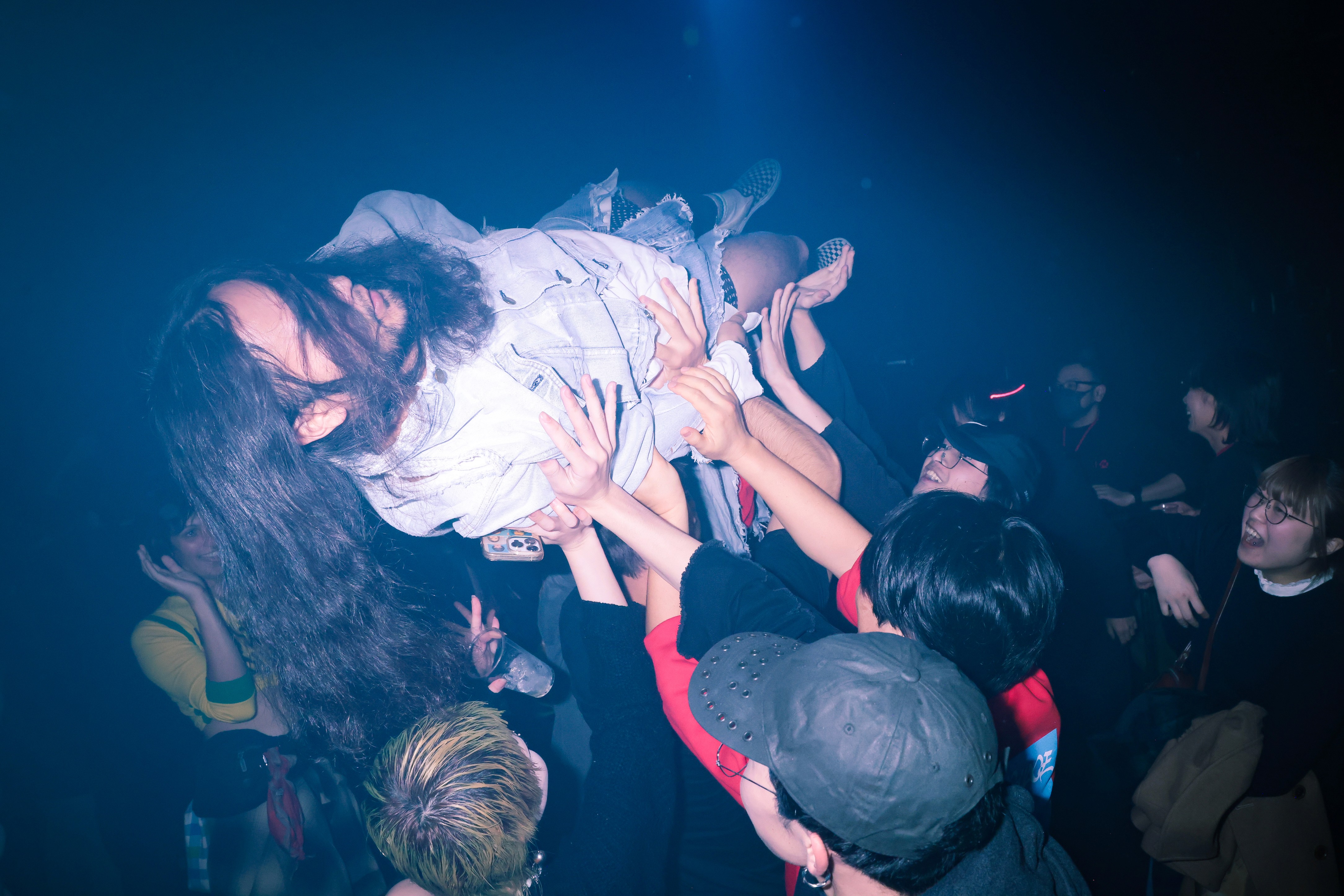
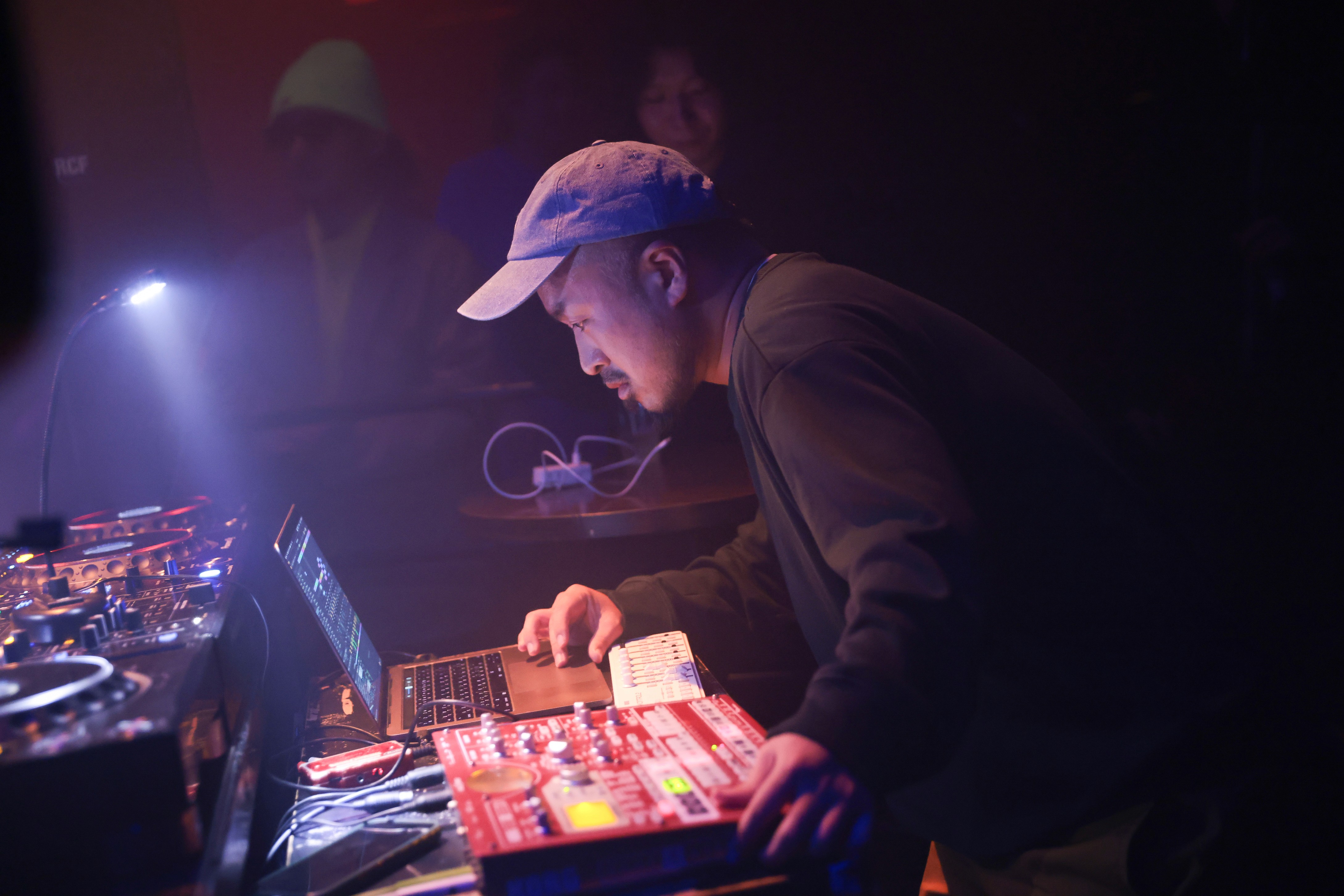
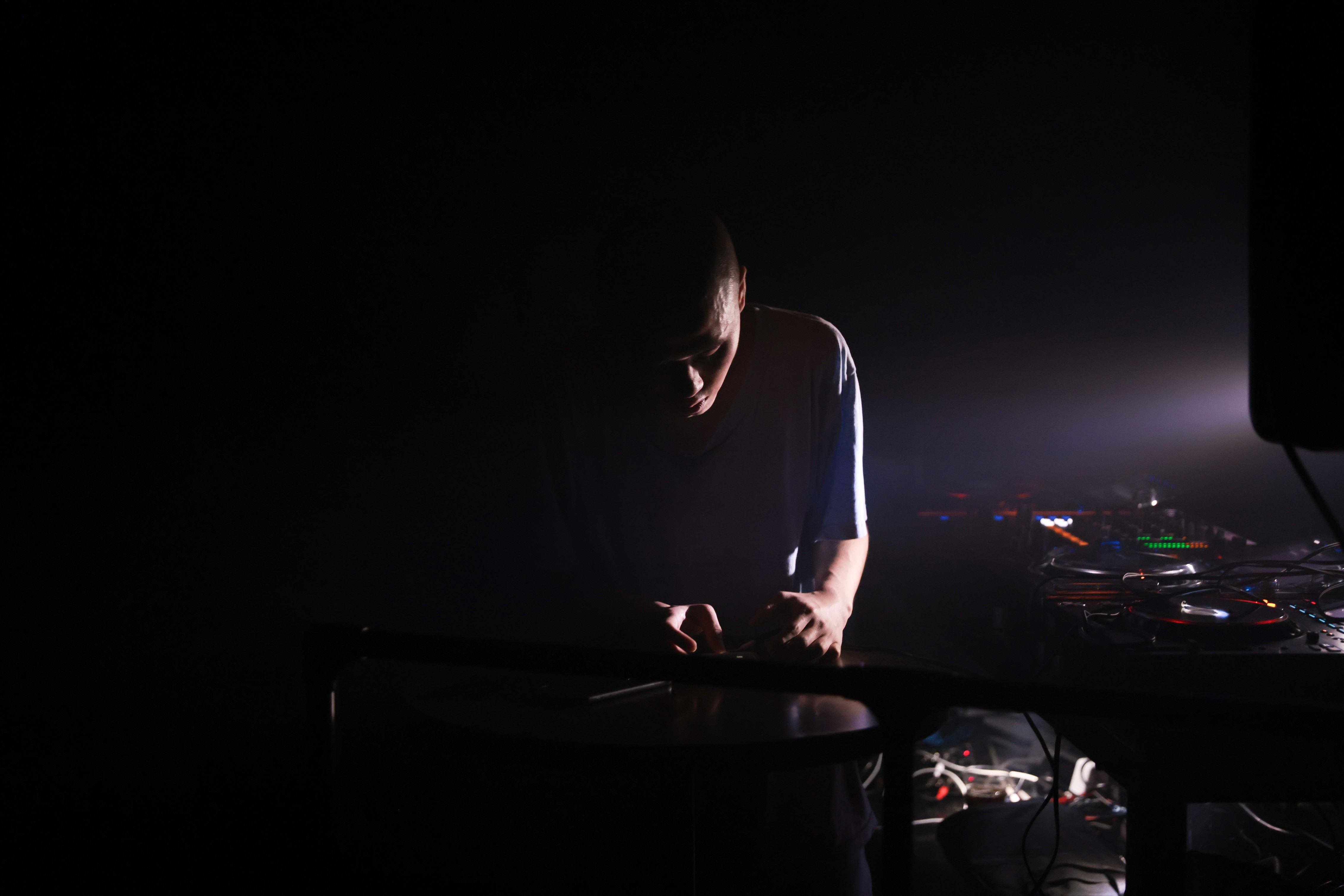
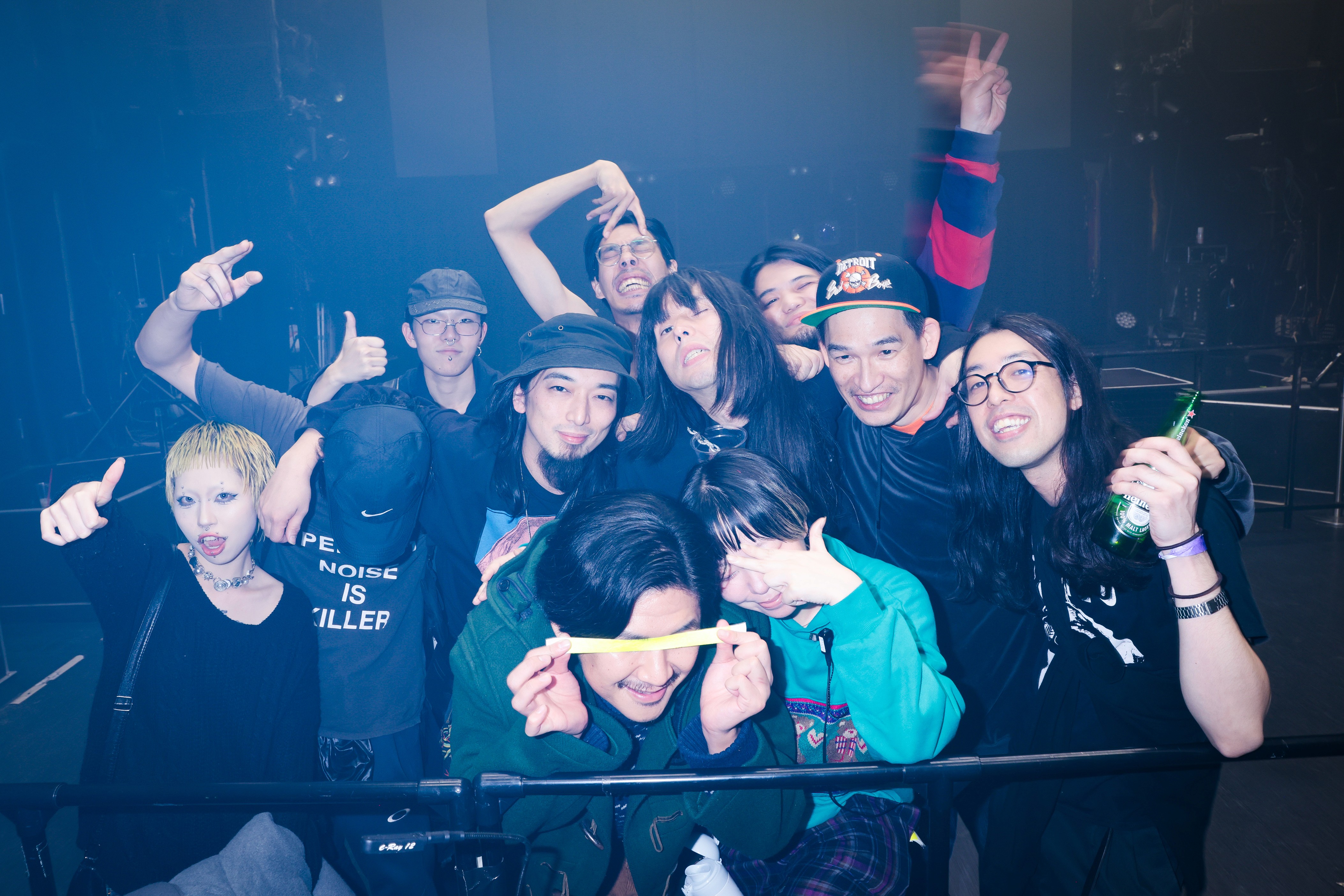
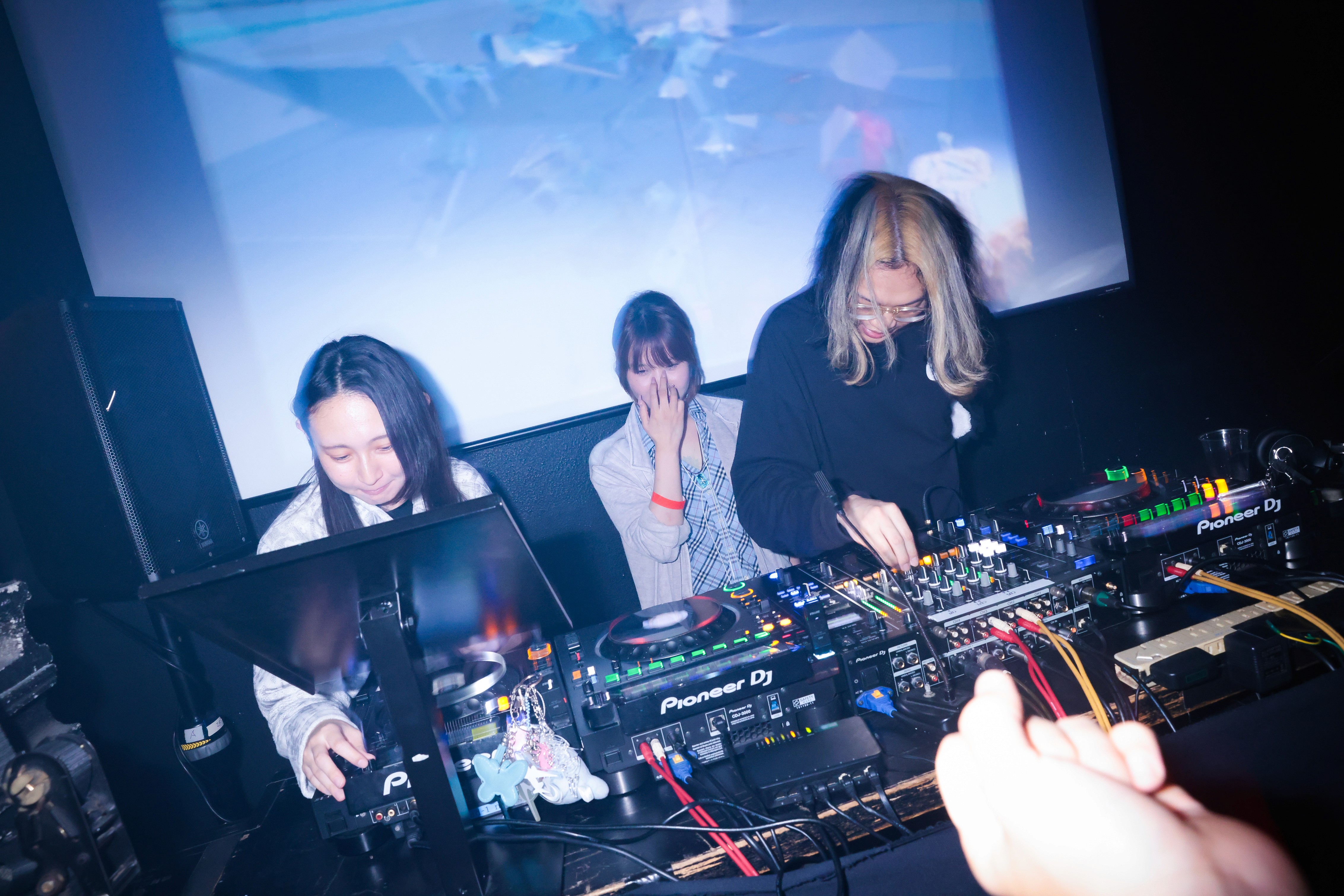
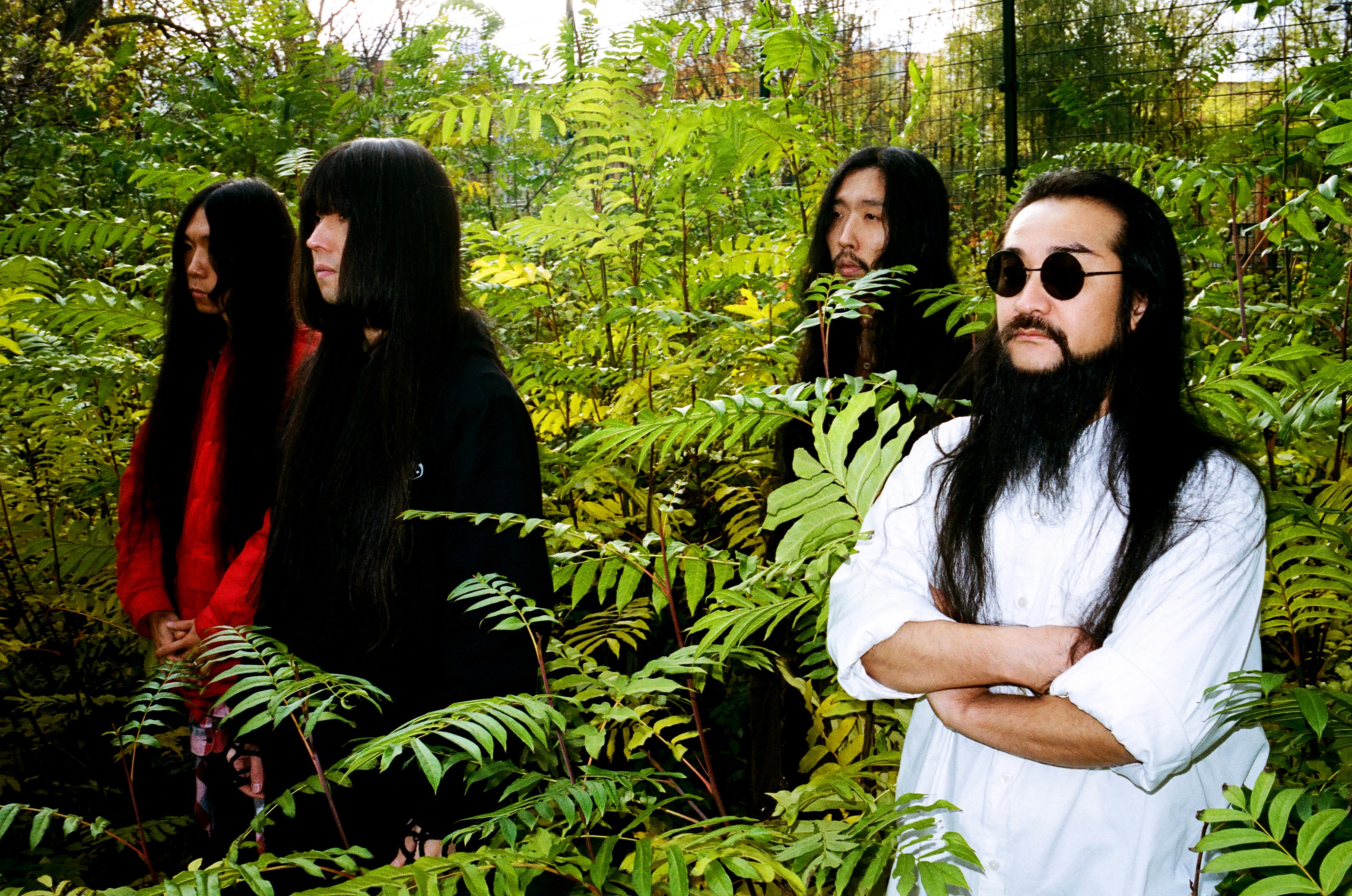
Bo Ningen: A Long-Awaited Return London-based Japanese 4-piece alternative rock band Bo Ningen have returned to Japan for the first time in three years. Their first show is a guest appearance on Christmas Day, at clubasia’s “clubasia THURSDAY: Holiday Rave Edition.” Their last appearance at a club event in Japan was January 8th, 2022, at Kaitai Shinsho’s 5th Anniversary party, and their last appearance as a band at clubasia was 12 years ago. So, we asked Kaitai Shinsho founder and organizer Romy Mats to join us for this interview with Bo Ningen members Taigen Kawabe (bass/vocal) and Monchan, aka Akihide Monna (drums) about their upcoming performance, scheduled a week after this interview took place.
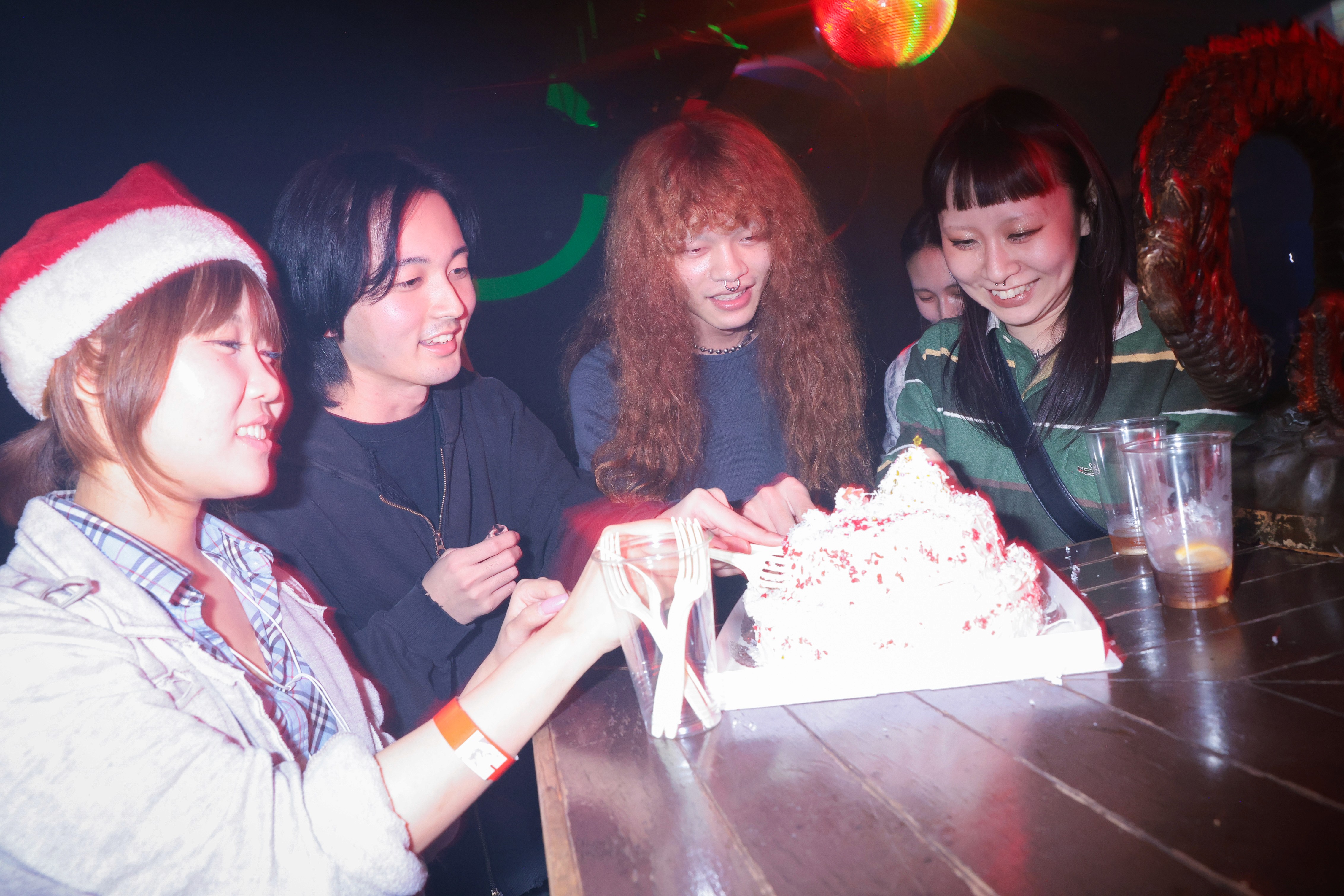
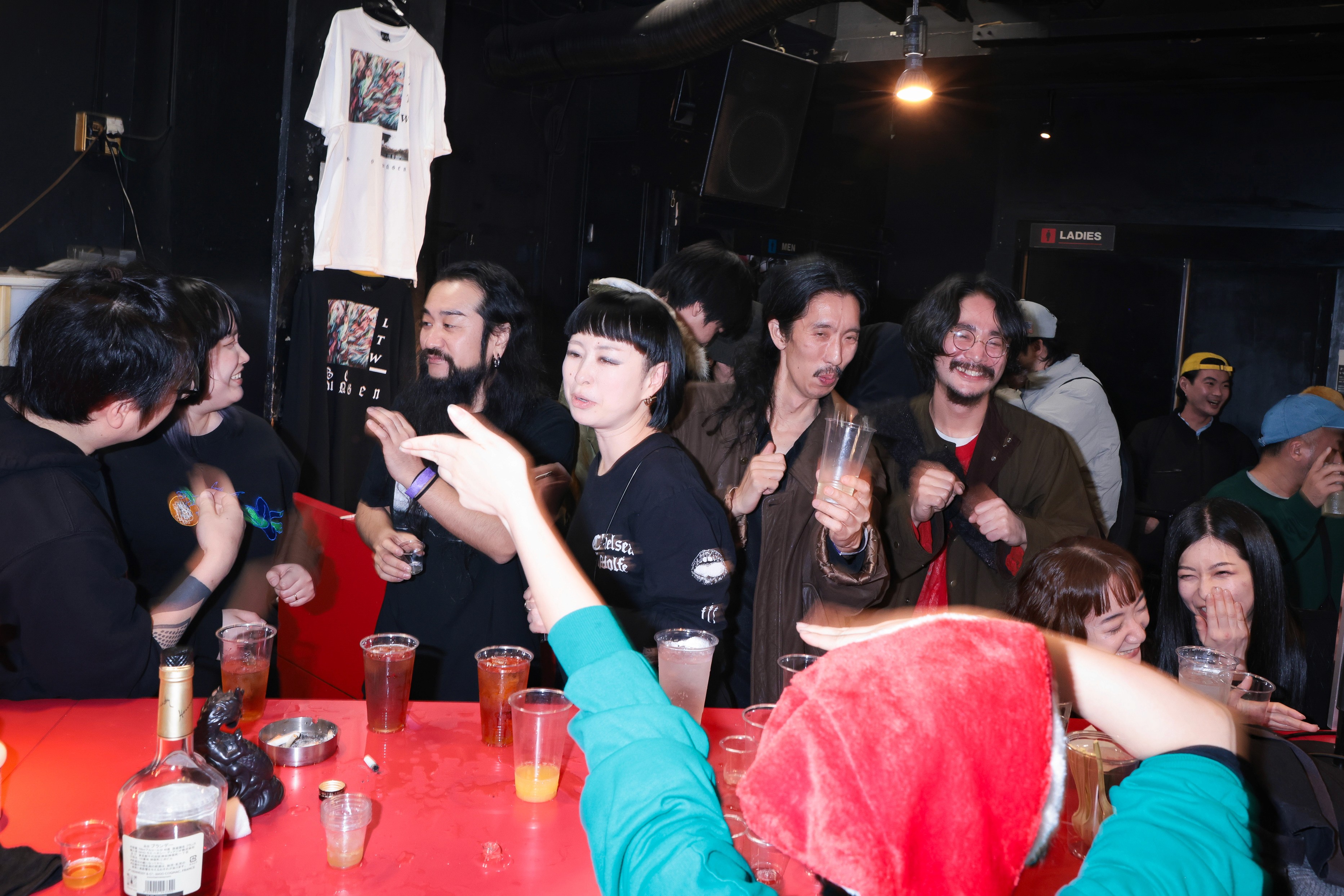
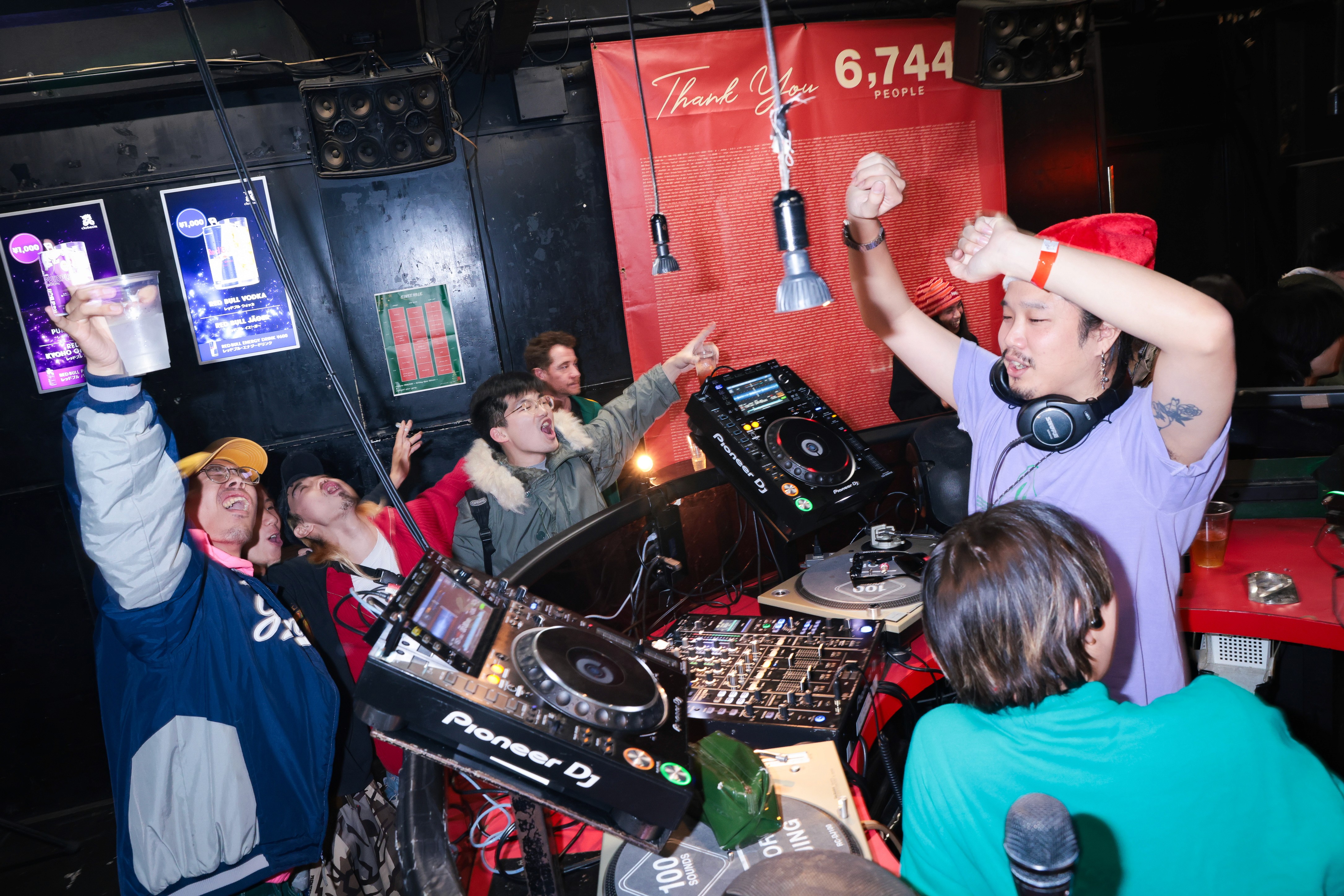
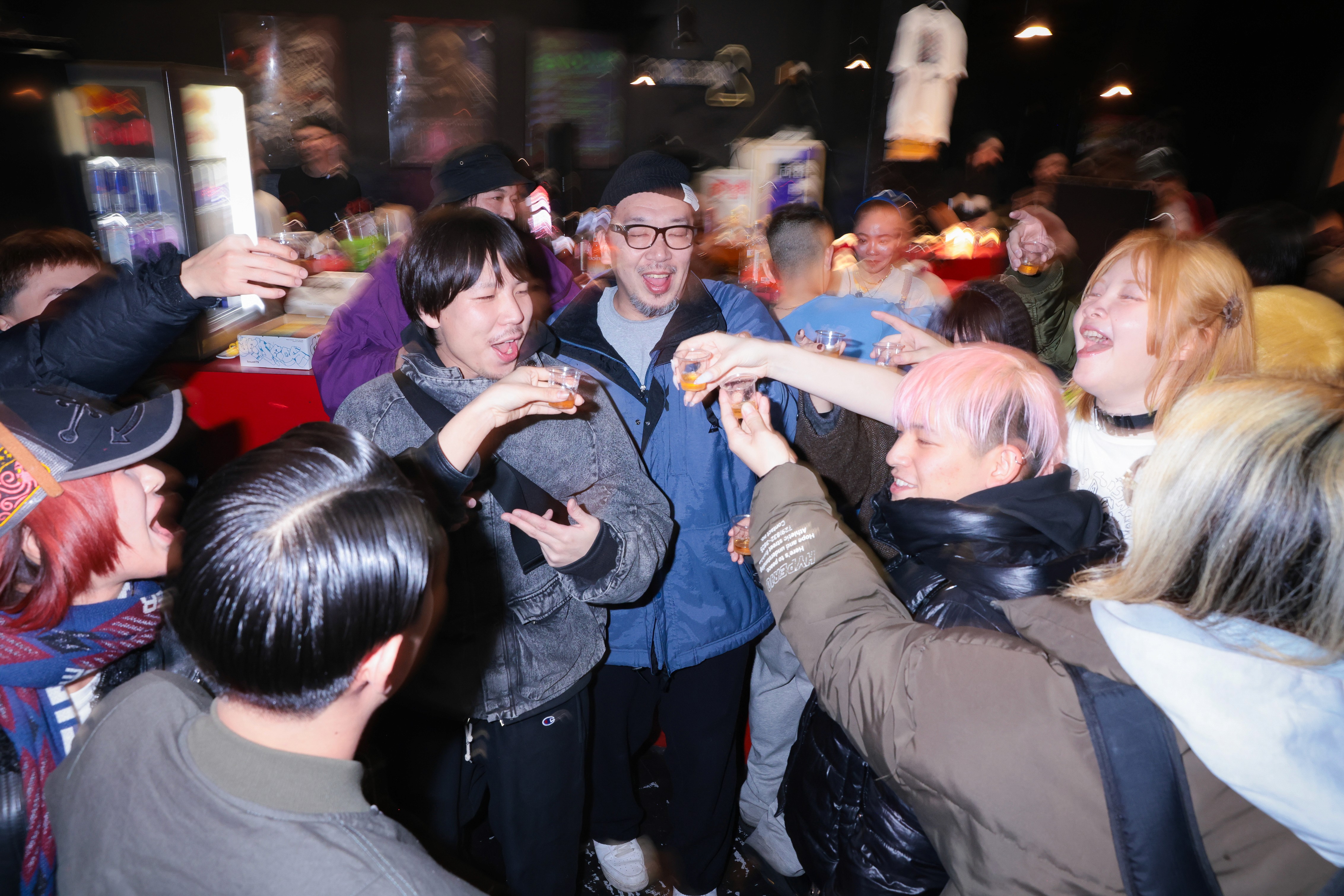
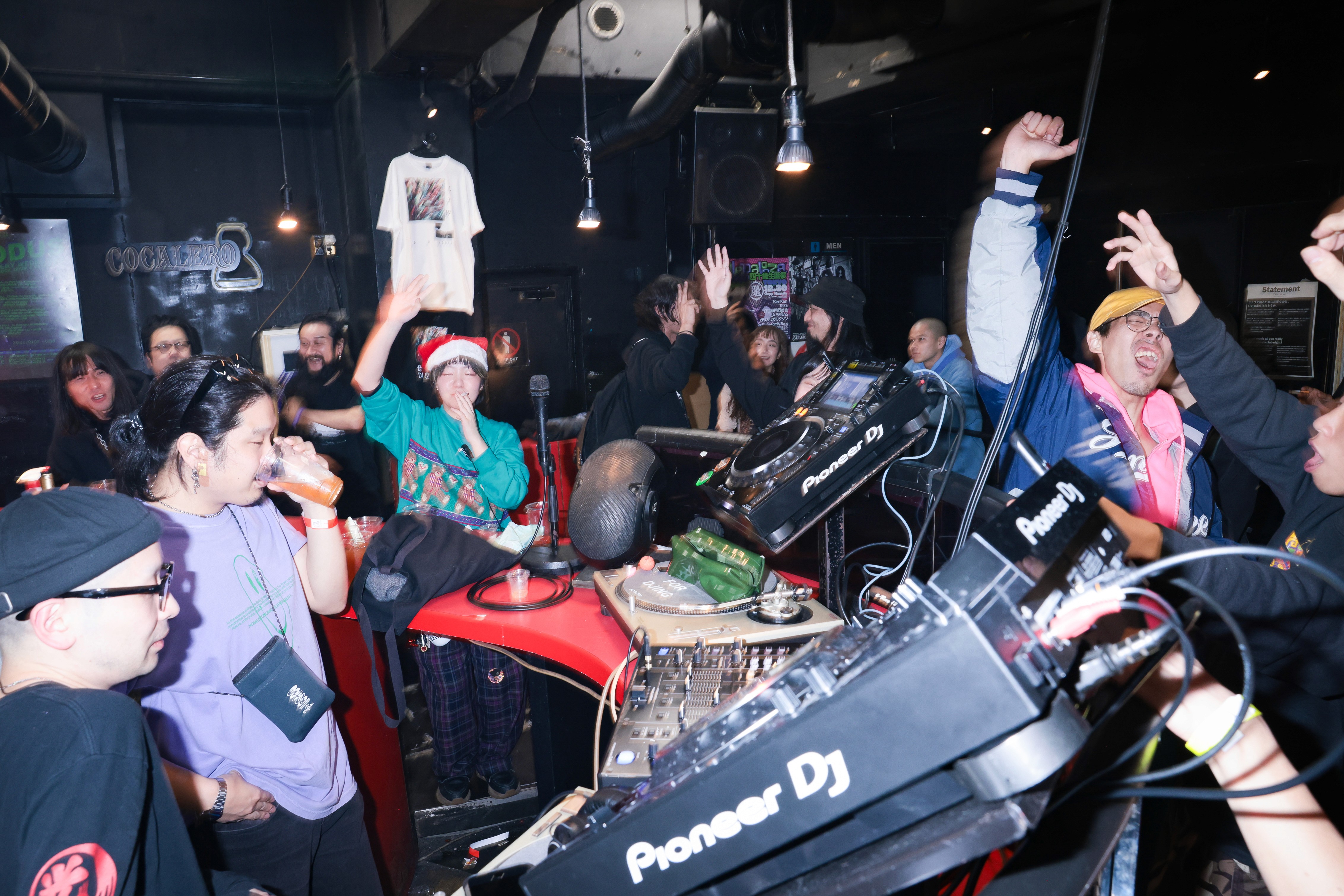
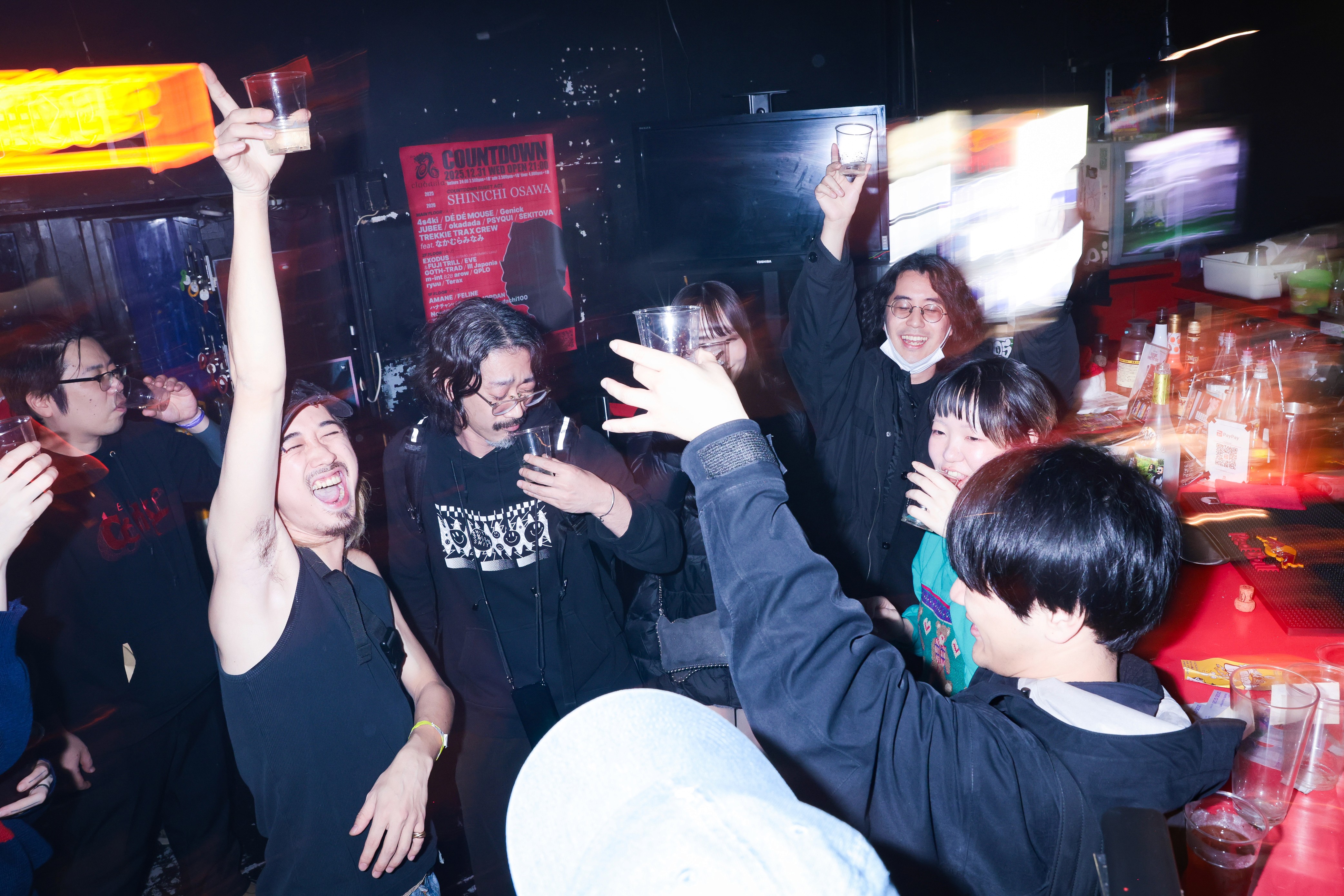
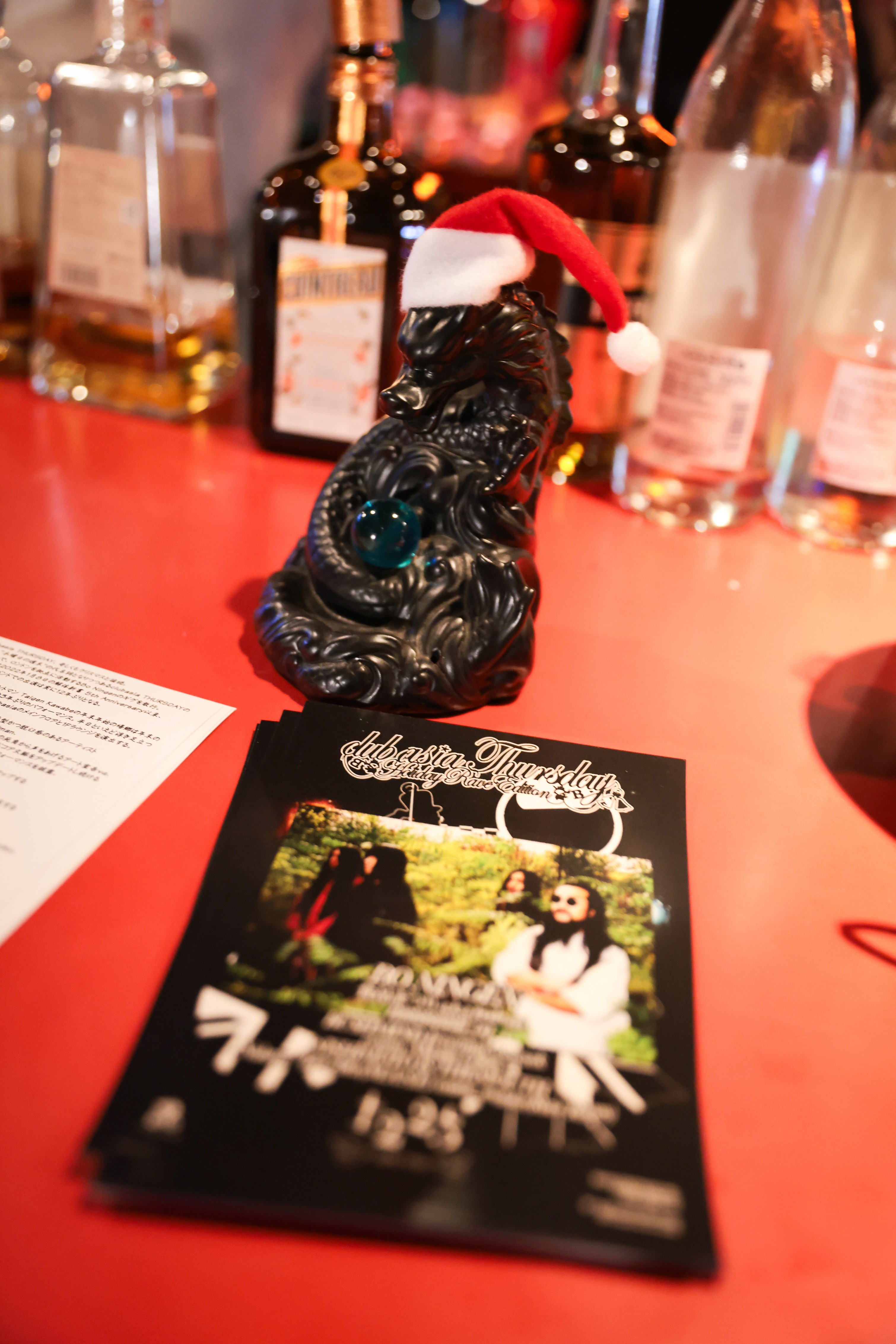
photo:
Toshimura
ABOUT BO NINGEN
A 4-piece alternative rock band hailing from Japan, Bo Ningen, long based in London, has performed on world-class stages like Glastonbury, Coachella, and Fuji Rock, and with legendary acts like Primal Scream, The Pixies, and inimitable post-punk pioneers The Pop Group.
In January 2021, they released their fourth album, Sudden Fictions, their first full-length release in six years. Produced by Drew Brown, who worked with Radiohead and Beck as an engineer, and featuring Bobby Gillespie of Primal Scream on its lead single “Minimal,” their work crosses generational and international lines, and has been well-received across the globe.
Romy Mats: First things first. I think we can all agree that there’s no need to be all stiff and formal with each other, right?
clubasia: To be honest, I’ve already started drinking.
Monchan: I mean, it is already that time in Japan, right?
Taigen: Yeah. I’ve got a Horoyoi open, too.
Monchan: It’s still a bit early for me. I drank way too much last night, too…
Taigen: Yeah, it was your birthday, wasn’t it?
ca: Happy birthday!
Romy Mats: So, it’s been three years, huh? Since your last live performance in Japan.


Taigen: Our last show was in 2022, at The Loft, in Shinjuku. Before that, we played at Ringo Music Fest.
Our last self-organized event was at Wall & Wall, and then I think we played at Romy’s party, Kaitai Shinsho, at Contact Tokyo.
Romy Mats: Basically, this is your first nighttime event appearance since that Kaitai Shinsho party, right?
Taigen: Yeah. We haven’t played a club event since then.
Seems like we go on at 3 AM, too.
ca: Yes. We have you scheduled to start at 3 AM. A bit bold, I guess. (laughs)
Monchan: No, it’s okay. Be bold.
Taigen: We went on at, what, 1 AM, for the Kaitai Shinsho show, right?
Romy Mats: Yep. ¥ØU$UK€ ¥UK1MAT$U went up after you guys.
3 AM is a good time, to be honest. Right about when people start going crazy. (laughs)
Taigen: This time, Bushmind will be going up after us, right?
And Foodman is up before us?
ca: Yes, that’s the plan.
Taigen: Hmm, maybe we’ll talk to him about how we can lead into our first song. Should be interesting
ca: It’s not every day that you guys play here, so we tried to set up a seamless flow, sort of.
Romy Mats: One of the best parts of night events, honestly. (laughs)
Taigen: Seriously. That feature of club events really is wonderful. At live events, they usually put a DJ between acts, and then start the act with some sound effects or something. It creates a different atmosphere.
ca: When we heard that you had two gigs planned during this trip, here at clubasia and then at Fever (in Shindaita), and that the Fever show would be a solo recreation of your Line the Wall show, we thought it’d be interesting to have that contrast.
Taigen: We appreciate it.
Romy Mats: Some time ago, when me and Taigen saw each other at an event, I think, we talked about how it’d be crazy to book Bo Ningen at a nighttime event. I don’t remember exactly what we said, though. I think we have a habit of talking by feel, a lot of the time. I think we mentioned chakra? Or something? (laughs)
Taigen: I think it was when I went to see you play at Forest Limit, Romy. I mentioned how I thought you had “high DJ chakra.” (laughs)
I think we also talked about the significance of bands playing at clubs at that time.
ca: I went to that Kaitai Shinsho show three years ago, too! I don’t think I’d have thought of this if I wasn’t there that day.
I still vividly remember listening to y’all from the front row.
Taigen: Thank you for using that opportunity to arrange this interview with Romy, too, on top of our show at clubasia.
Monchan: The lineup for the show is pretty wild, right? (laughs)
The kind of lineup that someone that knows Taigen well would look at and go, “Oh, yeah, mhm, I see.” (laughs)
Taigen: Like my whole life flashing before my eyes, an assembling of everyone I’ve gotten to know over the years. Sort of.
Monchan: I felt the same way. I was asked back in September to do a live performance in Gunma, and when the organizer asked me if there was anyone I’d be interested in playing with, I mentioned vq, even though I’d never met him, and Foodman, and we ended up playing together.
I’m really looking forward to playing with the two of them again in a different environment.
Taigen: When I saw vq at clubasia the other day, he said that you were “awesome,” Monchan. And I remember Monchan saying that he was awesome, too.
It’s wonderful to see [vq] playing all over with all these different people.
Romy Mats: When you guys play a Bo Ningen set at a nighttime event, do you approach the performance in a different way?
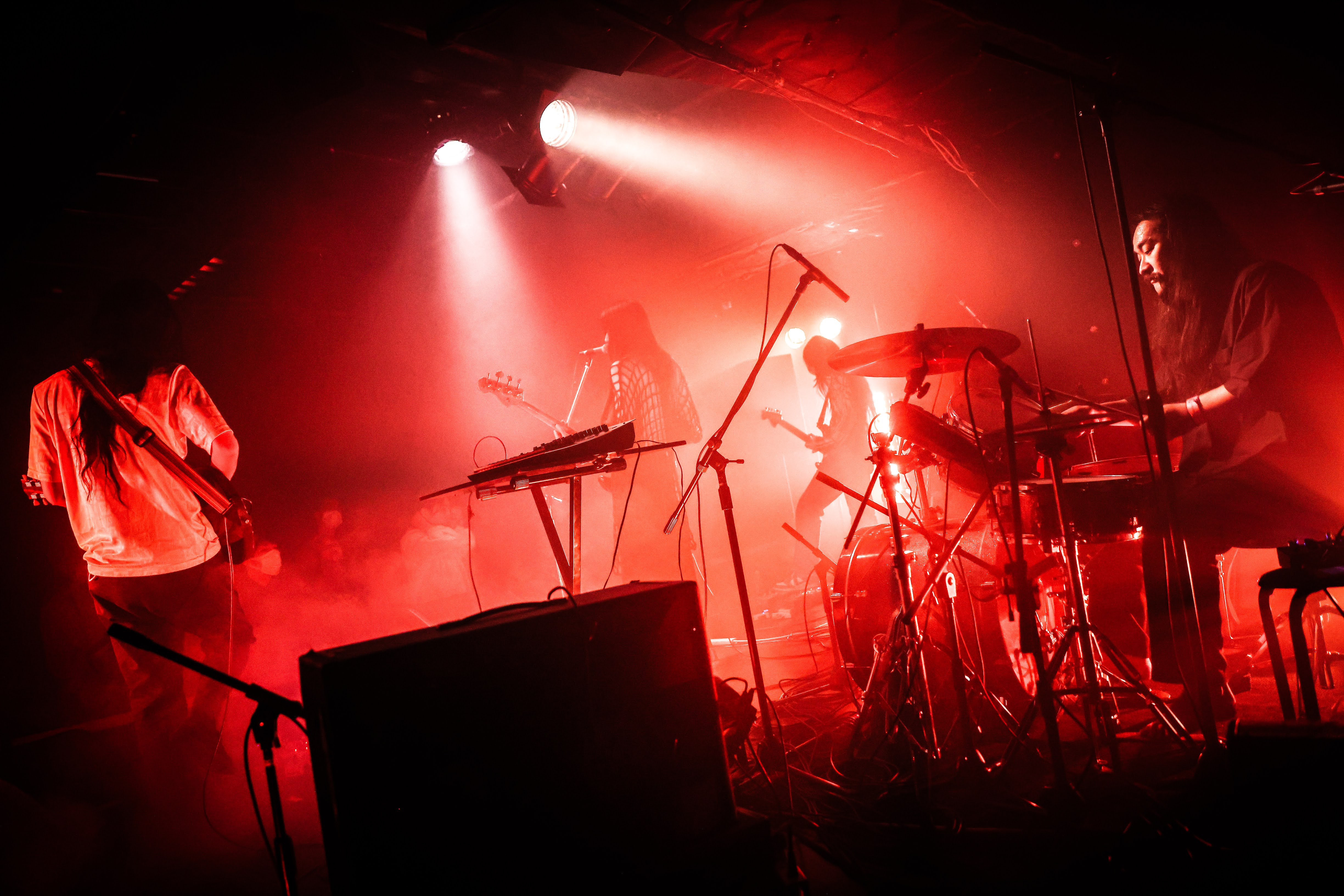
Taigen: When we play in clubs, we do have to consider the sound aspects of the venue. Like how much output the subs can dish out, etc.
I also think I end up playing my bass slightly differently as well.
Monchan: Normally, I think about maintaining a constantly high energy level, up till the last song, but when playing in a club, I am more aware about how I’m interacting with the bass, and about my low-end sound.
A more steady kick sound, if that makes sense.
At a normal show, we sort of aim for an attack, an explosive effect, and finish off with a happy ending, but in a club environment, we try to drag that out for longer, to keep up a feel-good vibe with the bass and the drums, I guess.
Romy Mats: That’s a pretty technical breakdown.
Taigen: It tends to get technical when we talk about our sound, but I don’t think we use technical elements to “control” our sound.
Our approach is still quite analog, and feeling-based.
Monchan: The amount of alcohol we’ve drunk also starts to become a factor at these events. (laughs)
I mean, with nighttime shows, it’s inevitable. Things start to blur together.
ca: You guys all drink a fair amount, right.
Monchan: We’ve all gotten far less tolerant of alcohol over the years, though.
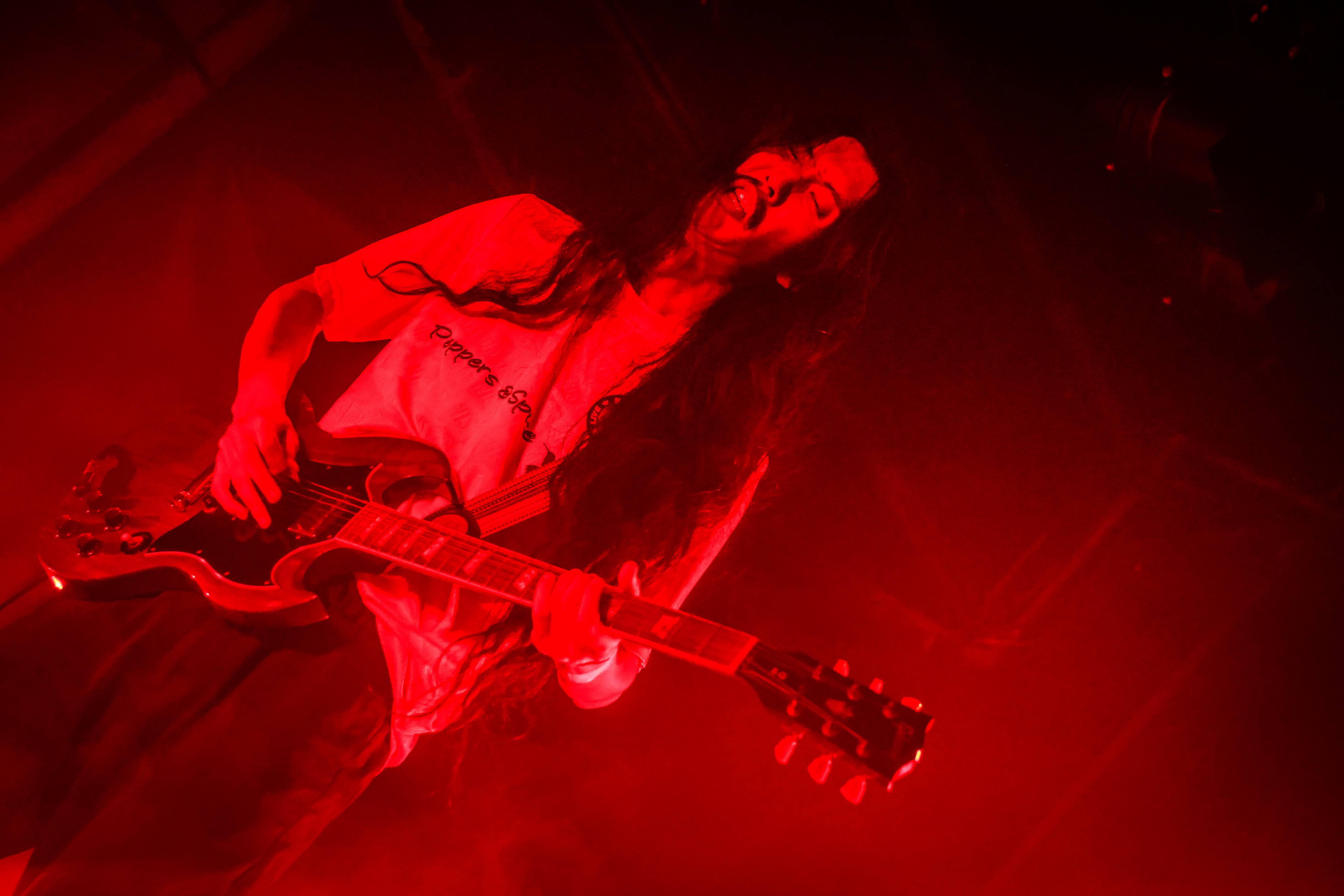
Our guitarist, Kohhei, tends to be the first one down for the count, so there’s no telling whether that’ll serve us for the better or the worse. (laughs)
Another reason why I think this performance will showcase a side of Bo Ningen people don’t usually get to see.
Taigen: I’m also really excited to party with the other performers.
Monchan: And yet, we don’t just want to stay cooped up in the green room.

Taigen: Definitely. Especially that day.
My mom, who’s also a musician, used to say,
Don’t stand at your merch booth before your performance.
You shouldn’t meet anyone before you play.
But at a club event, I think people actually go “Whoa, that’s awesome” if they see you dancing and having a good time. I personally have gotten a lot of bookings as a DJ and in other capacities just from going out to other people’s events, and I think the same should apply to us as a band.
And while I’m of course excited for the acts on the main floor, I can’t wait to check out the lounge area and second floor performances, too.
ca: This time, the second-floor event will be the afterparty for “nightpool,” a rave event that was held in November by Galaxy Chinchilla (宇宙チンチラ). Looking at the lineup for that event, it also kind of has a London-ish air to it, right?
Taigen: Yes. 2aby and isjm, younger faces that I got to know in London, are playing on the second floor, Masato Chiba is playing in the lounge, and Ozwick is playing the main floor area. Pretty much everyone that was holding parties in London is here.
Aligning with “nightpool” really was just a coincidence, too.
ca: It’s Christmas, after all, so we thought it’d be fun to just mash it all together into one big party! (laughs)
Taigen: Also, so many people were so fired up about it! They were all like, “I can play on the main stage! Please, give me a chance!” A lot of people straight up asked me if they could play that day. It really made me happy.
ca: If we had the time, we’d have loved to have them all, but you know how it is. (laughs)
Taigen: I guess this is how that “To be continued…” tagline starts, huh?
I thought about this when we played Kaitai Shinsho back then, but being able to show Bo Ningen to people that have gotten to know me outside of that context was such a joy.
They were like “Whoa, you do this stuff too?!” (laughs)
Foodman kept going “Oh, you haven’t seen Bo? You really should, you know,” as a joke. (laughs)
But yeah, having people I met through club events, etc., see and fall in love with Bo Ningen really was wonderful, so now that we get to do it again, for the first time in three years, I hope we can deliver an even more powerful version of that experience, the newest version of ourselves.
It’s also very emotionally fulfilling that we get to do it at clubasia.
Romy Mats: Four years have passed, and the Tokyo scene has changed a lot, to be honest. Contact Tokyo, where I had that party, doesn’t even exist anymore.
In these last few years, the distribution of the club scene, and the DJs in it, really has changed.
People like me, for whom going out on the weekends has become a big part of their life, I guess we naturally take a longer-term outlook on the whole thing.
But to you, Taigen, whenever you get the chance to come back, maybe things seem a little more instantaneous, like points in time.
I’m interested to know how you feel Tokyo has changed, from your perspective.
ca: These past few years, a lot of younger DJs have left to go to London, right?
I wonder if you have any stories on that topic, as well.
Taigen: I think you’re right in that I may see things from a point-to-point perspective. Coming back home for the holidays, or watching from afar, in another country.
During the pandemic, I think a new generation came out into the world, and nowadays, there’s yet another, one that didn’t even really experience the pandemic.
I think things have moved past just incorporating avant-garde sounds, or whatever. Things are getting more complex, more layered.
And in terms of DJing, there’s so many more players now. Maybe my perspective is a bit shallow, but everyone really is quite good, and that almost makes it hard to find people, sometimes.
So now there’s more parties, and more of them land on the same days, and maybe Tokyo now has the problem of having too many good clubs. (laughs)
I thought the scene shrank during the pandemic, but now there’s more players and venues than there ever were.
Romy Mats: Any places you’ve been since you’ve been back that you found interesting?
Taigen: I DJed at this spot in Shimokitazawa called Suns. It was pretty cool.
I didn’t know there was a place in Shimokita that you could blast deep, rumbling bass like that. It was very un-Tokyo-like, in a good way.
Also, I know it’s not an underground spot by any means, but I think the vibe of clubasia has also shifted.。
Last time we held a party there before going back to the UK, we asked them to set up 4 speakers on the second floor, and now you have parties like Exo, which only uses the second floor, and whatnot. Clubasia’s changes have really come to light in the last two to three years.
ca: I guess we do get Taigen to perform every year, either at our NYE Countdown, or at various other important events, so I think he really does notice most of these small changes.
Taigen: I’m glad I get to play so often here, and above all, that it’ll be with Bo Ningen this time, not as a solo act or as a DJ.
On Christmas, too, which makes it all extra special. (laughs)
ca: Hahaha.
Romy Mats: How does the modern club scene look to you, Monchan?
Monchan: Hm, I’m not quite sure. I’m not that much of a clubgoer myself, I guess, but compared to London, I guess the clubs here each have their own distinct flavor.
I also think what people seek from a club is a bit different here. You get a lot more stoic people.
Most places in London focus a lot on bass, and there’s a lot of places where people are happy if there’s anything playing at all, and even some that just aren’t that good. I think in Japan, things are a bit more thought-through, and more clearly designed.
There’s pros and cons to both, but in the case of London, I think there’s more room for places to be individual and unique, and that makes both highs and lows that much more dramatic.
In Japan, there’s definitely iconic projects with established ideas, like Kaitai Shinsho, and events and venues that have a strong core concept. But as Taigen said, a bunch of new places have popped up, and I feel like nowadays it can be hard to grasp the individuality and flavor of each spot.
Maybe this has to do with the events themselves. Everything’s good, the bar is pretty high, but I guess the sound has sort of converged, in a good way? In fact, I’m actually curious how organizers differentiate themselves now. If it’s okay to sort of turn the question back at you.
Romy Mats: Well, speaking for Kaitai Shinsho, I’ve always wanted us to stay firmly “alternative.”
Indeed, back when I had the pleasure of booking Bo Ningen, I felt like we, and my mindset in particular, were a little more provocative.
Ultimately, we want to do things that others haven’t, and want to share those things with others, and I don’t think that will ever not be our main goal. But recently, I’ve been wanting to create things you can only see, only experience at Kaitai Shinsho.
For example, having artists that only Kaitai Shinsho continues to bring to Japan. The foreign artists we booked this year were all ones that had played for us before, and I’ve been thinking more about how that relationship could become part of our expressive identity.
Taigen: Building that exclusive image and branding is important, for sure.
Romy Mats: Someday, I’d like to take this brand and our events and export them overseas. To London, for example. (laughs)
Taigen: There’s definitely an Asian boom going on right now, but there’s surprisingly little focus on Japan. This might just be the best time.
Romy Mats: If that does happen, I’d love to have Bo Ningen play again. (laughs)
Taigen: We’d love to be booked as London artists.
The night before ¥ØU$UK€ ¥UK1MAT$U played the ICA (Institute of Contemporary Arts) in London, we got dinner with him, and asked him what he was going to play the next day.
Apparently they wanted him to play a UK bass music-style set, but because it was to be in a museum, he wanted to play an experimental sort of set for the first hour, and then only play UK artists for the second half, he said. And when we went to the show the next day, he played a Bo Ningen song during that UK half of the set.
It felt great to be recognized in that UK-only portion of the set. We were like, thank you, Yousuke.
At the Kaitai Shinsho show, too, we ended our set with a big blast of noise, and right after that, Yousuke played our Ena Remix as his first song. That was awesome.
Romy Mats: Yeah, it was.
ca: I think Mr. Yukimatsu is wonderfully giving and generous in that way, but at the same time, it feels like he must have played those songs because he really wanted to.
Taigen: Yes. And so, even though things are a little different this time, I’m still really excited to see how and what Bushmind plays after our set is done.
Romy Mats: Following up a band as a DJ really makes you think.
Taigen: Have you had to do that before, Romy?
Romy Mats: Definitely. You know that a good number of people are going to leave the floor, but at the same time, you want to stop as many people as you can. It becomes your mission. (laughs)
My first song after a band set is always something I’d never play if I was following up a DJ act.
I guess I tend to pick songs that have a really strong hook to them.
Taigen: Gotta tell everyone that this isn’t their bathroom break time. (laughs)
It’s always great when the music that comes on at a sort of switch in the program is great. The kind that doesn’t step on the vibes of the previous act but still gets you fired up for the next one.
That lukewarm metal they sort of just drip into venues between acts really doesn’t get you excited in any way, you know? (laughs)

ca: It really is hard to decide which DJs to book to play before or after bands and rappers.
Romy Mats: I love them to death, but I think the set I had before Kukangendai was one of the hardest I’ve ever had to play.
Taigen: That’s definitely an interesting story. (laughs)
ca: I’m sure you guys have opportunities to play at club events in London, too; is there anything you’ve noticed that’s unique to the way that Japanese clubs organize and structure their events?
Monchan: I can’t help but remember the time we played in Serbia.
They asked us to play for their New Year’s Eve countdown, but the whole event was pretty disorganized, and it ended up running three hours behind schedule.
So they came to us at 3 AM and were like, “Uh, you can go on now,” and it was like, the countdown’s long gone, man.(laughs)
ca: Hahaha.
Taigen: Well, that wasn’t really a club event, to be fair. It was like a rave sort of thing. (laughs)
In terms of nighttime club events, before Kaitai Shinsho, we had the privilege of playing Star Festival, which is, of course, a Japanese event. I guess it is a festival, but I’ve always felt that in Japan, we have the freedom to try new and different things, to challenge ourselves.
Romy Mats: Bo Ningen truly is perfect for late-night slots. I’m having trouble verbalizing just quite why, though.
Taigen: That makes me happy to hear. Of course, hearing that we resonate with club music or late-night hours links us with my own personal tastes, and that’s always good to hear.
Romy Mats: But, in terms of your output, none of it is “dance music,” per se, right? You’re definitely not a “dance rock” band, or anything like that.
Taigen: Yes. We don’t have anything that’s an easy interpretation of some sort of dance music.
That sort of stuff doesn’t fit Bo Ningen’s vibe, anyway.
He doesn’t play anymore, but there’s this guy Shark (Shark Yasue), who was the drummer of Gezan. I remember something he told us once.
We played together several times, and after we’d gotten close, I asked him, “How was Bo Ningen different from the way you imagined us?” He said, “Y’know, you guys are way more like bass music than I thought you’d be.”
ca: Hahaha.
Taigen: It was interesting that he felt that we were bass music-y, in that sense.
Even though everyone has a different way of saying it, I get the feeling that he was getting at a sort of central aspect of our sound, the same one that makes you and others say we fit late-night slots well.
Romy Mats: I guess the place you live and the air you breathe really does get expressed in your outlook.
Taigen: Definitely. Even in Japan, rural areas feel so much different than Tokyo.
I’m actually in Oita right now, and these local clubs really are so unique.
I went to a party organized by some younger kids, and they opened their late-night event like they were starting a rave. It was so cool to see a scene outside Tokyo that I’d never interacted with before. (laughs)
ca: It’s always easy to tell when a DJ has cut their teeth in a rural scene or at a local venue. Even after they come to Tokyo.
Taigen: Is there anyone like that in this lineup?
ca: Hmm. I’m not sure where he’s actually from, but I get that feeling from Ozwick. And I mean that in a good way.
I liked his work before I got to know him, and he’s spent time breathing that London air, as you said. He also cut his teeth in Shimokita, which is a pretty “local” Tokyo scene, so I think he builds grooves in a pretty different way.
Taigen: That makes sense. I suppose his “rural” area wasn’t in Japan, but in London. (laughs)
I played in Oita with Ozwick, and I felt that that environment might have been the right place to bring out the energy we’d gained at Fold (a warehouse-style underground club/art space in Canning Town, in East London).
I think Japanese DJs try to adapt to their listeners, or at least to find the sort of sound that fits best for the speakers they’re playing on. And this is true in Tokyo, too.
Romy Mats: Yeah, I think we tend to, uh, harp on that a bit. (laughs)
Or, well, we’re at least trained to take that into account, I feel.
As Monchan mentioned earlier, I don’t think there are many spaces where it’s fine for there to just be any sort of music at all. Music being there is obvious.
The question becomes, how do we improve the quality of that music. I think all of Japan takes this quite strongly to heart.
Taigen: Everyone’s very earnest about their craft.
Romy Mats: Even if we look only at clubasia, the level of quality that people aim for is very high.
I’d love to get an engineer in and do a real sound design project one day.
Asia’s most famous clubs, the ones that foreign artists always hit on their tours, rarely ever have a PA for their parties [while clubasia almost always has one].
ca: I think those places have very little of that DIY spirit. Which is a good thing, to be honest.
Romy Mats: We’ve definitely jumped around from topic to topic, (laughs)
But I wanted to talk about Bo Ningen’s career. I looked it up prior to this interview, and it seems you guys have been active for nearly 20 years.
Taigen: It’ll be 19 years next March.
Romy Mats: And you’ve been based outside Japan nearly the whole time, right?
It’s pretty amazing that you’ve been able to continue playing in such an environment.
Taigen/Monchan: Thank you.
Romy Mats: Keeping at it is itself very difficult, and a precious thing to be able to say. I assume there’s been countless changes amidst it all, but what would you say is the reason, if there is one, why you guys have been able to keep at this one thing for so long?
Taigen: Because we’re Japanese. (laughs)
At least, that’s what Kohhei said, when he was asked about a similar thing a while back. He said it as a joke, but I think our Japanese background helps us stay peaceful, I suppose.
We often get told that we’re “very close,” and whatnot. I guess that may be a bit different, but you know.
Monchan: Well, we really are calm and peaceful with one another. Even in comparison to other bands.
Whenever I hear about other bands and whatnot, I’m just like, yeah, that’s not the case with us.
I don’t know how much this matters, but for example, all of us have different blood types.
Taigen: Yep. And everyone’s family, like how many siblings they have, etc., is different. (laughs)
Monchan: I guess we have a good balance, in that sense.
ca: All of you have long hair, though.
Taigen: I guess that’s the one thing we didn’t look at when deciding our member lineup. (laughs)
Monchan: We’re all laidback, in a good way, and I think we don’t really impose too much on one another. And because we’re all living away from home, we’re sort of doing this in an environment where we’re not sure if we’ll survive or not, so I think we all understand that we need to stay moving.
That good sort of unbalancedness is a driving force that keeps our wheels turning.
We were never public enemies or anything, but when we had visa troubles, or what have you, we’ve been able to band together against that common enemy, I guess. We’ve had many experiences like that.
I suppose there’s also a difference between bands that can work to let off steam, and those that can’t.
At any rate, it’s about to be 20 years since we started, and I think we should do something.
ca: Are you guys planning anything?
Monchan: This is honestly just a joke, but there’s a town called “Boningen” (in Switzerland). Would be cool to do a “Boningen × Bo Ningen” event. (laughs)
Taigen: It would. (laughs)
But we would love to do something in Japan, too.
Romy Mats: You really should.
Back to what you said previously, but as an artist active in a place that is not the one you grew up in, does London really feel like home?
Taigen: I think we think of ourselves as being based in the UK and in Japan, and of both places as home.
Monchan: We do distinguish between the two if we need to, though. (laughs)
We can use either for excuses, for example, so I think it’s good for our mental health. Like, oh, we haven’t been in Japan recently, so we’re not quite familiar with that, or whatever. (laughs)
Taigen: Yeah, that too.
Romy Mats: After having done this for nearly 20 years, I’m sure there’s been more than one turning point or inflection point for you guys. How has Bo Ningen come to terms with the changes and flaws it’s faced so far?
Taigen: There’s been times where we made good music, but we had come to terms with the fact that we’d done stuff like that before, or working on not getting too trapped in our image as a “live band that is loud, chaotic, and psychedelic.” All of our members have dealt with this stuff at one time or another.
Right now, I think we’re figuring out what new direction to strike out in, what experiments to do and where to search, how to become “catchy,” and how to maintain all of those things in the right balance.
I don’t think we’re as worried about doing things that have or haven’t been done before.
Monchan: Yeah, I feel the same. I don’t think we want to create things in line with some preexisting idea or direction, to sort of put things together to achieve an imagined result. We want to take time to explore things that each of us don’t know, and that we assume the rest of us don’t either.
To use sculpture as an example, we’re molding clay, then shaving it down, then adding more, then shaving it down, then firing it, and at the end of it all we’ve made a tree. But that tree is not one any of us has ever seen before, not a species that we’re familiar with. That, I think, is the goal we’re aiming for, and we’re in a long process of trial and error to get there.
What we consider to be good, what we want to do, if it’s something we can concretely explain with words, then it’s probably neither of those things.
Even more abstractly, perhaps what we’re thinking about when creating is how to continue our process of trial and error until we reach a good landing point, so to speak.
And in that sense, too, I think it would be good to plan something in Japan.
Romy Mats: I get what you mean, in a broad sense. Kaitai Shinsho will also turn 10 years old the year after next.
Because we’ve been at it for so long, I think I understand what Monchan was talking about, about solidifying something, shaving it down, adding something else, and thinking it’s complete only to break it all down, if only as someone that has also done something for a long time.
That’s why I want to tell people that have just started DJing or holding parties that “no matter what it looks like, or how often you can do it, continuing to do something is the most precious and important thing of all.”
Monchan: Exactly.
Romy Mats: It feels great when something comes together, but refining it, iterating on it, adding new things, that feels even better.
Monchan: It’s a pain sometimes, but the artistic process itself is important, and something we’ve also constantly felt.
Whatever you feel after listening to this music just once, I personally think that that’s not enough. When we’re interviewed about this work, itself a product of some significant thing, I think the people that hear or read this interview can better grasp that thing.
Just tuning out and listening on Spotify because it happened to come up is a bit different, I think.
ca: I’m glad we’ve kept up this DeepCuts series. Interviews like this are wonderful.
By the way, it’s been 12 years since Bo Ningen last played at clubasia, right?
Taigen: Yes. Our last performance was during the day, so-called “live show time,” and not during the late “club time.”
Romy Mats: Keeping at it for long means that sooner or later, you’ll be able to say things like “it’s been 12 years.” I know it must feel pretty crazy.
ca: Your show at Fever in January is going to be a “Line the Wall” set, as you’ve said, right? Part of me wants to know what sort of set you’ll play at clubasia, and part of me thinks it’s probably better to just wait and see.
Taigen: We haven’t had a chance to sit down and fully plan it all out, but personally, I’m thinking about a secret show we played to commemorate a collaboration we did with Jawara Alleyne, a Jamaican fashion designer.
We played in a space that basically had no equipment, and brought in everything ourselves.
That gave the show a strong DIY vibe, and I thought that that sort of set would do really well in a club setting.
I wanted to suggest that to the other members, and while I don’t plan to do the same set at all, I think including that DIY vibe will let us bring out a vibe totally different from what we’re aiming for at our Fever set.
And like we said, we gave a more ravey feel to the groove, and I took a different approach to my rhythm and my vocals.
I think that vibe would fit clubasia well.
Doing something that we pulled off well in an unequipped space in a well-equipped one, well, even in that unequipped space, it came off super ravey, and I think we really had something there. I wanted to share that idea with the other members.
And I want to build a set around that feeling.
Monchan: That sounds good.
Romy Mats: I feel like I just eavesdropped on a Bo Ningen meeting.
But yeah, I guess you guys don’t play one song, end it, and then do a hard switch to the next.
You kind of mix them together.
ca: Maybe that’s just what people would want to see in a club atmosphere.
Romy Mats: Wow, I guess we’ve been talking for about two hours now. (laughs)
Let’s wrap it up with a bit of a cliche question. How are you feeling about your show on the 25th?
Taigen: Personally, it feels so much like my whole life flashing before my eyes that I need to watch out for dying somewhere along the line, like all the foreshadowing we’ve done until now paying off. Of course, we’re aiming to deliver on that day, but at the same time, we want people to know it’ll be the start of a story, too.
We plan to burn ourselves to bits that day, but it’s still just a beginning. Moving into next year, we’re starting another Bo Ningen story, and we’ll do whatever we can, but don’t forget to imagine a little “To be continued” at the bottom.
It’s our first performance at clubasia in a long while, and we aim to bring things together and push them into 2026.
Monchan: I feel the same. This year has really been about returning to our roots. We first did the “Line the Wall” show in April, and now we’re recreating it in January, connecting those two points in time. Our show at Asia will be our first in 3 years, and I think we’re going to play songs we’ve never properly played in Japan before. Old and new alike, I think we can bring forth a culmination of everything we’ve done up till 2025, and we’re going to give it our all.
And we also plan to not get too caught up in the moment and drink too much. We’ll control ourselves and make sure we break down at the last moment, on stage.(laughs)
ca: That makes this sound like a very scary party. (laughs)
Romy Mats: It’s the end of the year, after all, and it feels like this will be a turning point.
Taigen: Definitely.
Monchan: Let’s close it out right.
Taigen: Yeah. Let’s close this out right.
Romy Mats: You guys sound like a baseball team. (laughs)
ca: I hope we can say that on the day of, too. Let’s close today’s show out right!
Starting from the pre-show meeting.
Taigen: Sometimes, before we play, we get into a huddle. (laughs)
ca: Do the huddle on the day of, too!
Taigen: I’m here in Oita now, and I’ll be using this hot spring water to wash away my bad karma and purify myself in time for Christmas. Hope to see you there, fresh and clean.
-------------------------
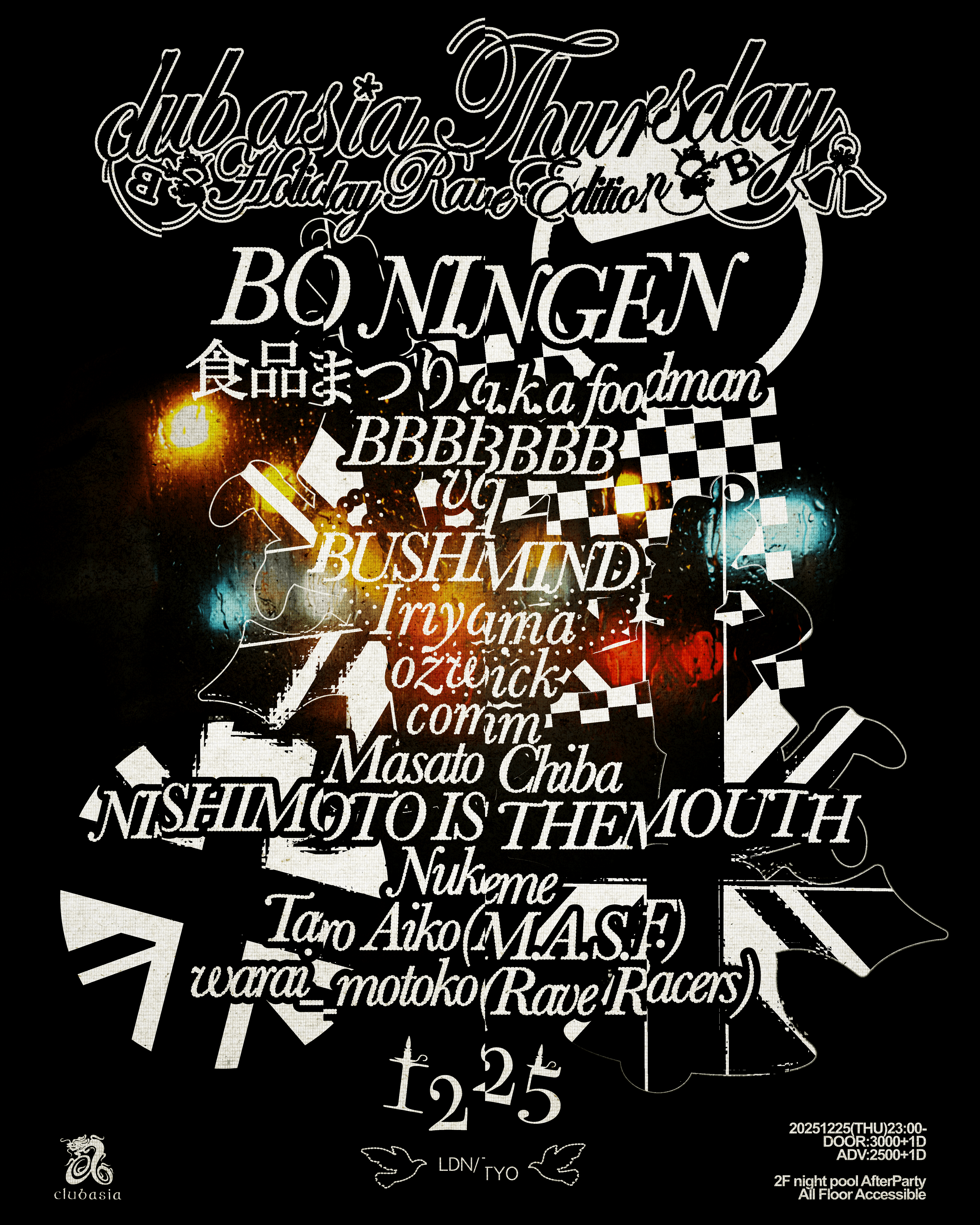
《MAIN FLOOR》
🎁LIVE
Bo Ningen
食品まつり a.k.a foodman
vq
BBBBBBB
🎄DJ
Bushmind
Iriyama
ozwick
《1F LOUNGE》
🔔DJ
Masato Chiba
warai_motoko(Rave Racers)
NISHIMOTO IS THE MOUTH
comm
Nukeme
Taro Aiko
《2F FLOOR》-nightpool after party -
★DJ
2aby
489
DREAM FIGHT CLUB ( meweta & 夏至 )
isjm
Lil Peace
Pussycats ( Lo-Fi & unkokitty )
Y2M4K3R
night pools
★VJ
刀匠
★XmasCake
nonoka
🔁回遊可能
《PHOTO》
Toshimura
- OPEN 23:00
- PRICE
*DOOR ¥3,000 +1D
*ADV TICKET ¥2,500+1D
<https://cultureofasia.zaiko.io/e/clubholidayrave>
<https://ra.co/events/2322013>